Friday, January 10, 2025

Fluoridation Barely Fails a Risk-Benefit Test

Epistemic Status: back-of-the-envelope. I am about to present a bad cost-benefit analysis of fluoridation. However, something is better than nothing, and I have not seen anyone else do this.

Summary: Fluoridation causes more monetary harm than good if it causes an average IQ point loss of more than 0.2. According to a recent meta-analysis, the effect size from high-quality studies is 1 IQ point loss per 1 ppm fluoride. Fluoridation adds about .5 ppm. If this effect size is accurate and fluoride has a linear population-level dose-response function, then fluoridation would lower IQ by 0.5 points. If you place more than 40% credence on this, and/or if you think that the non-monetary harms of IQ loss are larger than for caries, then you should oppose fluoridation.

Background: I used to think that fluoridation was mostly harmless, and that fears were overblown. But I have changed my mind based on new evidence appearing in the scientific literature. I agree that this new evidence has problems, but it shows that there is real uncertainty and risk.

If we lived in a world without fluoridation, then under the precautionary principle, we would not be starting it now. Everyone agrees that high amounts of fluoride (>2 ppm) are harmful, nobody knows what the safe threshold actually is, and we do not have enough evidence to rule out a linear-no-threshold dose-response function. 

But I prefer to do public policy based on cost-benefit analysis rather than the precautionary principle. The question then becomes how to weigh the possible IQ loss against the known benefits of fluoridation.

Breakeven Analysis: When the situation is uncertain, it helps to conduct a breakeven analysis. So I calculate how much IQ loss would cancel the known benefits of fluoridation.

The CDC says that fluoridation has an economic value of $32 per person per year, and other sources agree. So over your lifetime, you will get about $2500 of money benefit from fluoridation. The monetary value of one IQ point is about $12,000, which is about 5x the benefit of fluoridation. So if fluoridation costs the population 1/5th of an IQ point, it does more economic harm than good.

In reality, money is a small part of the equation. Cavities cause pain and suffering, and the DALY loss for lower intellectual function is significant. But if the ratio of non-monetary to monetary harms are the same for both conditions, then the breakeven will be the same.

Personally, I think that the non-monetary harm from IQ loss is significantly larger than the non-monetary harm from caries, such that the total harm from losing 0.1 IQ point is roughly equal to the total benefits of fluoridation reducing cavities.

Risk of Harm by Fluoride Dose: On an individual level, the dose-response function is rarely linear. There is usually a non-zero point where harm is minimized, and the marginal harm per unit usually increases as the dose (or the background exposure before the dose) increases.

However, we are not dosing an individual. We are dosing a population. Most people have significant background exposure to fluoride from other sources. If a significant number of people already have a baseline exposure to fluoride greater than the harm-minimizing point, then any amount of fluoride added to the water will harm them. We know that at least single-digit millions of people are above this level, and it is possible that many more are.

The population-level dose-response function is based on how many people are already beyond the harm-minimizing point, and how far they are beyond it. At low levels, it only harms vulnerable sub-populations, but eventually it harms everyone.

We do not know, based on the data we have, what the population-level dose-response function is between IQ and fluoride in drinking water between 0.2 and 0.7 ppm in a developed country. But here's what we do know from the meta-analysis (Table 2):
1) There is strong evidence that, above 1.5 ppm, 1 additional ppm fluoride in drinking water will lower population-average IQ by about a point.
2) There is weaker evidence that the dose-response is roughly similar below 1.5 ppm, and not enough evidence to rule out a linear effect model.

Conclusion: Personally, I would assume that the dose-response at lower levels is about half what the paper estimates, meaning that fluoridation has caused an IQ loss of about 0.25 on average. I would further assume that most of the loss is concentrated in vulnerable subpopulations, with a median IQ loss of 0. 

So I believe that fluoridation is probably beneficial for most people, and that it probably causes total harm to the population slightly larger than its benefits. Getting rid of it would slightly increase social welfare, and also decrease inequality.


Monday, September 9, 2024

Mortality Cost of Taxation

Here are some interesting questions:
1) If Japan raises $1 billion by increasing taxes on investment income, how many people will die as a result?
2) If Kenya raises $1 billion with a bundle of sales taxes, how many people will die as a result?
3) If the USA raises $1 billion with a tariff on Chinese goods, how many people will die as a result?
(If it is not obvious to you that these numbers are all more than zero, consider the basic facts that poverty kills people, and taxes take money from people. I like telling people that cost-benefit analysis is how to do "primum non nocere" for public health policy.)

In a competent civilization, there would be an academic sub-discipline devoted to these Mortality Cost of Taxation (MCT) questions. University professors would research MCT methodology and develop MCT best practices, and there would be a neutral MCT agency in all G20 countries that estimated the mortality effect of every tax policy under consideration. Then people would estimate how many lives would be saved by spending the tax money, and compare. (In reality, they would use a metric like the DALY, to account for both quality and quantity of life lost, but I am focusing on deaths in this discussion to keep things simple and vivid.)

In the world we live in, this academic discipline only exists in my head (as far as I know, and I would love to learn otherwise), and I suck at it. The best answer I can give is:
1) Ask a taxation or tariff economist how much the policy will impact GDP.
2) Divide that number by the country's GNI per capita.
3) Divide that number by 100.

So, in Japan (GNI/cap $40k), every $4 million in economic impact will kill someone, and in Kenya (GNI/cap $2k), every $200,000 in economic impact will kill someone.

My answer assumes that all taxation is basically the same, and assumes that the inverse of the MCT, i.e. the amount of economic impact that kills someone, is roughly half of the Value of Statistical Life (VSL). So if the VSL is $14 million, then $7 million in economic impact will kill someone. This is the best I can do, and it probably isn't wrong by more than an order of magnitude. 

VSL estimates come from looking at the wage differences between similar jobs with different occupational fatality rates, for example lumberjacks and gardeners. In the USA, for every $13 million or so in increased wages among we-assume-otherwise-identical jobs, one person dies on the job. In Kenya, many more people will die for $13M in increased wages.

If everyone responded to the tax increase by working a more dangerous job, then the VSL would be the correct estimate of the MCT. But this is obviously impossible at a societal level; the composition of jobs is roughly fixed and the tax change does not alter occupational safety standards.

If everyone was perfectly rational and made consistent tradeoffs between money and mortality risk, then the VSL would be the true estimate of the effects of people reducing their consumption in response to a tax increase. But we know that the all-cause mortality rate among people with dangerous professions is higher, so they cannot be turning their extra income into lower risk via consumption at the VSL rate.

For this reason, and for various other handwavey reasons I can't formally justify (e.g. budget constraints, short-run elasticities being lower, behavioral-economics effects, and vaguely gesturing at the literature on how people respond to income shocks), I assume that broad-based income loss from taxation or tariffs turns into mortality at roughly twice the VSL rate. (i.e. If the economic impact is $1 billion and the VSL is $10 million, then the taxation will kill about 200 people.)  Although I still use the VSL in all my work, because that is the current methodological standard and I can't cite anything better.

If you think you can do better, or know someone who has done better, or would like to collaborate to find ways to do better, please let me know.

PS Obviously the story becomes different with more targeted taxes. Taxing rich people causes less mortality (assuming that the tax incidence actually falls on them). Taxing harmful substances or things with negative externalities could have zero or even negative MCT, if it doesn't move much activity into a violent black market. I would assume that taxing positional goods causes roughly zero MCT, but there may be weird side effects I am not considering.

PPS It's a weird feeling to be so bad at something, and also the best in the world, because nobody else is even trying. I have looked, and can't find any discussion of this. Maybe I'm just missing it. But in all the discussion of VSLs and how to use them and how to derive them, nobody seems to justify the methodology by pointing to the harm of taxation, or to make the obvious point that taxation kills people so it would be nice to know if your policy is saving more lives than it kills.

Tuesday, October 10, 2023

Notes on Gaza

I want to start by making it absolutely clear that I am on Israel's side. The people of Israel deserve to live in peace and security, and achieving this should be our main concern.

I'm writing this because it's epistemologically virtuous to make public predictions. I put roughly 80% confidence on any statement that I make here. If I'm wrong about this, and I hope that I am, I will update my worldview accordingly.

This attack has been called Israel's equivalent of 9/11. I agree. They were both horrible terrorist attacks that wounded the soul of a nation. And I fear that the government of Israel is about to make exactly the same mistake that the US government made after 9/11. 

The correct response to 9/11 would have been to lock cockpit doors, invest in better policing and intelligence, use some diplomacy to reduce the amount of money going to Wahabist training centers, and do nothing else. Instead the USA started a punitive military action without a real plan. That military action killed more of our people than the actual terrorist attack, burned three trillion dollars (which using standard VSL calculations is the equivalent of killing 300,000 Americans), seriously harmed our moral standing in the world, and did very little to protect us or prevent future attacks. (I credit the lack of subsequent attacks to better intelligence, better police work within our borders, and a few targeted assassinations.)

I think that the correct response to the Gaza terror attack would be to upgrade air defense systems, install drones or turrets that are capable of shooting down paragliders, strengthen the border fences, maybe encourage civilians to be better-armed, and do nothing else. But the government is making an emotional decision to go in guns blazing without good intel and without a plan.

I think that going into Gaza is going to stick the Israeli army into a sausage grinder, like the US army in Iraq or the Russian army in Ukraine. I predict that more Israelis will die as a result of reacting to the terrorist attack than were killed in the actual attack, and that military intervention will do little to improve their long-term security.

The hostages are a much harder question, but the fact that Hamas took so many of them is an indication that previous policy has failed. Governments need to make a credible promise to never negotiate with hostage takers. I would prefer to live under a government that never paid ransom, but instead worked to find and carpet bomb any facility where hostages are being held. This policy would dramatically reduce the chances that I was taken as a hostage, and even if I was, I would much rather die in an airstrike than be used to give a billion dollars in funding to a terrorist group that would use that to kill more people.

Without any moral condemnation, and with a full understanding of why they chose to do this, I will point out that the past Israeli blockade of the Gaza strip has been a failure. It did not prevent attacks, and gave people motivation to launch them. Punitive collective punishment does not work, and it breeds more terrorists. The economic situation in Gaza has created a situation where it's very easy to recruit people into a terror group.

Israel has chosen to shut off the fuel and electricity and other essentials of modern life to a group of 2 million innocent people and a few thousand terrorists. This policy will create more terrorists faster than Israel can kill them. If my little sister froze to death because of a foreign government shut off heating oil, and threatening to bomb any aid convoys, I would want to go out and start killing them, and there are a lot of young men in the Gaza strip who will react the same way.

The correct long-term solution would be to give Gaza to Egypt. Cede the territory, let the city be part of Egypt, integrated into the Egyptian economy with free movement of people, and fully under control of the Egyptian police and security forces. Let young men leave and work elsewhere in Egypt, so you don't have the 90% youth unemployment that always breeds violent rebellion. This would not reduce the risk of Gaza-originating terrorist attacks to zero, but it would make Israel a lot safer than any other policy.

The USA and European countries should negotiate this transfer, if necessary paying Egypt some money to compensate them for the costs of integration.


Thursday, February 17, 2022

Why you are psychologically screwed up

Epistemic status: deliberately written in simplified tale/myth mode. I could go off on so many tangents on the actual complexity and nuance of everything, but I wanted to keep it tight. I encourage you to 'unpack' the points by comparing them to things you know, and/or framing what I say in different ways, to see if the main theme/message makes any sense to you.


1: Monkeys Become Ants

In the beginning there were monkeys. Individuals had their own models of physical reality, and desired things, and took actions based on their desires and reality models. This often involved fighting the other monkeys to get something. Life was solitary, poor, nasty, brutish, and short.

And then something happened. Some monkeys became more cooperative and social. They formed packs, and the packs were more successful than the individuals. The monkeys in packs coordinated their actions and learned from each other. Homo sapiens crushed its competition and filled the world.

Making the pack work required a lot of psychological engineering. People had to be programmed to replace their own desires and world models with the shared desires and models of the pack, at least when it was necessary for the pack to cooperate and do something. People who were unable or unwilling to do this were selected against.

Over time, cultures and religions and ideologies learned new tricks to enable cooperation at larger scales. They became more aggressive about replacing the desires and world-models of people with those of the group. People were acculturated to deeply internalize the group's desires and have faith in the group's description of reality, such that going against either was somewhere between morally abhorrent and unthinkable.

The groups that were capable of generating cooperation/brainwashing at scale crushed the ones that had less ability to do this. Eventually giant hiveminds formed, after figuring out how to brainwash millions of people into useful cooperation. They came to rule the world, and people who were unable or unwilling to be assimilated into these mega-hiveminds were selected against.

In short, monkeys were psychologically manipulated into sometimes acting like ants. It didn't matter how traumatizing this process was, because the hive minds that did it won the fight against those who did not, and filled the world with their genes and memes.

Because of this, most people usually operate on a level of social reality, rather than physical reality. The hivemind doesn't want you to have your own model of the physical world, unless you are one of the few ordained specialists in having that job. Having your own model is a rebellion, a rejection of the cooperation protocol, and marks you out as a cancerous or treasonous element.

Similarly, having any desires not programmed or approved by the hive marks you as a threat. You are rebelling by doing the abhorrent/unthinkable thing. If the hive learns about this, you are in trouble. If you make it common knowledge that you have this, and are proud and open about it, such that you are making a public challenge to the cooperation protocol, you are in very deep trouble.

2. Evolved Hypocrisy

But humans did not become completely eusocial; we continued to reproduce as individuals. And there was plenty of opportunity to steal from the hive for personal gain, for those clever enough to do so without getting caught.

In addition, being one of the people with power at the top of society requires you to act as an individual monkey. You have to see the world as it is, and take action and make actual decisions. Hiveminds that completely destroyed the ability of their leaders to act as agents did not last very long. In addition to the leaders, the successful hive minds also allow a small number of artists or inventors who think creatively, if they prove their loyalty and quality in other ways.

So there was always a trade-off in incentives; a complicated tension in strategies. Someone who was too individual was rejected by the hive and exiled or killed for being a criminal or misfit. But someone who was too much of a drone, who sacrificed too much of themselves to the hive, also failed to reproduce. The only people who survived were the ones who managed to resolve this tension and manage the trade-offs appropriately. Everyone else was selected against. 

And the ones that really prospered were the 'sleeper agents' who rose through the ranks, or gained acclaim, while seeming to be very loyal to the hive and following its commands, and once they got enough esteem and resources, acted as a self-interested monkey (ideally while making the hive more powerful, but this is at most a secondary goal).

This manifests itself in several ways, such as widespread hypocrisy, self-deception, and hidden motivessocial desirability bias. But the main evidence is Near/Far Thinking. Roughly, far mode is the hive's programming, and near mode is taking care of yourself and your genes. People who cannot manage this switch appropriately will be selected against, and one of the better predictors of being able to do this fluently is your brain lying to your conscious awareness about what you are doing. Another piece of evidence is how easily and thoroughly organizations or subcultures can suborn individuals and turn them into drones who only value the hive.

So, for hundreds of generations, people were selected for their ability to be hypocritical, play social games, and selectively violate rules when necessary while pretending to follow these rules in public. 

They were also selected for their ability to deploy appropriate strategies. Being more monkey-like (being an agent with unique goals and ideas) is the high-variance play. If you fail because you are not good enough, you're a misfit and criminal and get eliminated. But if you succeed, you rise to the top. Acting like an ant, maintaining pious or bourgeois respectability and following the rules for a non-elite existence, was usually the safe strategy if you had the ability to follow the rules and be productive, but not the skills to play the game of thrones.

3: Mythologies of Desireless Reaction

All of this has been happening for thousands of years. But recently, the hive's programming changed in ways that further crush individual desire and agency, disrupting the balance that previously existed and causing even more psychological damage.

One of the main tools that hive minds use to acculturate and brainwash people is narrative fiction. The widely shared foundational stories and myths of their society tell people what they should desire and how they should behave. In this way people are deeply programmed at an early age to act in a certain way.

In the past, most stories were heavily gender-coded. Boys were told to act a certain way, which usually involved having desires and being actors or subjects, but in a responsible and controlled way. Girls were told a different set of stories, which usually involved following the rules and being passive objects of desire. This was bad and hurt people, but as I've said before, the systems that made themselves more powerful were selected for, regardless of the harm to individuals, and systems that made more of their people more ant-like had a competitive advantage.

For most of history, whatever the medium, from Odysseus to Tom Sawyer to pulp magazines, the male stories told of heroes who had desires and took action to achieve those desires, but who did so in a virtuous way, while respecting the (more important) rules of society. In this way they modeled good behavior, teaching people to strive for things without hurting others. In this fiction, the importance of following certain social rules was emphasized, often much more so than in modern fiction, but the heroes were allowed/encouraged to follow their goals as well.

And then The Lord of the Rings was published, and everything changed.

This was a huge cultural event. It spread widely. More and more content creators started to imitate it in various ways, consciously or not. More and more narrative fiction published since then has followed its basic pattern:

The hero does not have personal desires. The hero does not wish to do anything other than live a normal boring life according to society's rules. And yet, they are forced to take action by an outside evil force that wishes to impose a change on their society. For some reason, the hero is chosen, through no merit or virtue or action of their own, to be the one person who must protect their society. But they are quite clearly an object of the story or its situation, rather than a subject.

Star Wars mostly follows this pattern. The hero is living on a farm, evil people force him into action, and he acts for the benefit of others with magic powers that he did nothing to earn or deserve. Harry Potter follows this pattern even more so, as does basically every superhero story.

In the very earliest superhero stories, they were, somewhat, proactive agents of change. They cleaned up the criminals that were the normal part of their society. But nowadays, superheroes are always reacting to some kind of super villain who has an evil plot to change the world. Their success is defined by returning to the status quo. (Avengers: Endgame is especially notable for this; they have unlimited power and just use it to restore what was lost. Nobody even mentions improving things; the least they could have done is to get rid of Malaria, AIDS, and TB in the process.)

In all of these works, which have become the de facto civic religion of our society, the heroes are all fundamentally both reactive and reactionary. They're not trying to accomplish anything; all they're doing is stopping someone else from taking action. It's vetocracy as a foundational myth.

And so, through an incredibly powerful multi-sensory experience, repeated many times and in many variations in many narratives, all young children nowadays are trained to believe that the ideal behavior is to want nothing, to take no action, but to rise up in arms against anyone who would change the structure of your society. They are taught that taking initiative is bad, that researching technology is bad, that making changes is bad, and that all good people must resist these things, but of course you should not take the initiative to resist them, some situation outside you must force you to take action. We are brainwashed to want nothing more than to be a high-status protagonist in a story written by someone else.

And it is not just the fiction. Many other tools of social programming are also saying the same thing.

As you might suspect, this messes people up a lot. And as you should expect from knowing that your conscious brain is mainly a PR agent, people will not know that they are messed up, or why.

It's not a coincidence that our most successful people don't consume fiction, and that some of our more original and agent-like thinkers were socialized by old science fiction rather than modern narratives.

If you are trying to raise a child to be individual and sapient, to have its own desires and goals and to believe that it is okay to work to achieve those goals based on a personal model of the world, practically your only hope is to have no screens they can access, and keep a library of nonfiction scientific books and maybe some old science fiction and even older stories about responsible heroes with initiative.

4: The Over-Programmed People

Even with the change in social programming, most baseline humans are hard-wired with enough subconscious cynicism to figure things out, and enough hypocrisy to act for themselves in spite of the rules. Thousands of generations of evolution have shaped them to handle this situation. They act according to the rules and standards in public, while maintaining some capacity for private action that breaks the taboo against initiative. Usually they do this by arranging situations of plausible deniability (humor and irony are used heavily here), or simply breaking the rules after sending or receiving signals that the other person is willing to break the rules with them.

But some people don't figure out how to play these complicated games, and they suffer.

There's a behavior cluster that I've noticed that I don't think we have a name for. There is a lot of correlation between having this behavior and having scrupulosity or being a high-functioning autistic, although neither is quite the same thing. Basically the behavior cluster is acting too much like an ant and not enough like a monkey.

Even without the cynicism and hypocrisy, most neurotypicals have a defense against the anti-agent programming. They have a high baseline of selfish-monkey traits, which means that when society's behavioral programming forces or trains them to follow the rules and be obedient, they end up somewhere in the middle. They restrain their instincts for grasping desire when necessary, and follow them when appropriate.

But some people don't have this. They believe the rules, internalize them deeply, and follow them without adding in any monkey instinct. They think that if all they ever do is follow the rules properly, then they will be taken care of. They are too nice, too agreeable, too passive, too much like a drone. They share information instinctively freely and honestly, and jump to follow the commands of a perceived authority.

(Things can get especially rough for someone who believes the rules taught in school science classes about using evidence and the scientific method. They end up as too much of a drone, without significant individual desires other than the desire to be respected and accepted by the hive. But they are also too much of a monkey, because they insist on using their own mental model of reality rather than deferring to society's.)

The normal people reject the over-programmed people for being freaks, even though the over-programmed are doing exactly what everyone around them says everyone should be doing. This is partly because of an instinctive revulsion for anything that is seen as different, because most mutations are bad and people who made friends with mutants were usually selected against. But it is also true that, compared to a clever hypocrite, the over-programmed do not make good friends or partners. They're less likely to obtain resources, and less likely to preferentially give those resources to their friends. When you are an obedient drone, equally giving to every member of your society, and displaying no preferences or nepotism, nobody in your society has any incentive to be your friend.

It's likely that a lot of people reading this are over-programmed people. I personally am and/or was one. In the past, I would rage against the unfairness of the world. But the more I learn about the way the world works, and how selection has inevitably shaped human behavior, the more I learn to replace my moral indignation over other people's hypocrisy with an understanding that I'm just a dysfunctional mutant.

Epilogue: The Future of Humanity

Some people, who have internalized the old system of gendered stories that program people in different ways, call the result of the new programming 'the feminization of society'. A lot of men have noticed this process and complained about it, and feel nostalgic for the old model of civilization where only women were programmed to lack desire and agency.

I think that it was bad in the past when women were robbed of agency and desire, and that it is even more bad now when everyone is suffering this kind of brainwashing and programming. 

It is possible that civilization can only function when most people are turned into ants. But it seems to me that if you have more state capacity, and fair and automatic systems of law enforcement, then brainwashing people is much less necessary. They just need to be smart enough to understand that hurting people or stealing things will lead to automatic and overwhelming force directed against them.

However, it may not be possible to arrange this, and it may be true that the old gendered model is more sustainable than denying agency to everyone, by which I mean it is better able to project power and crush its opponents. If some non-Western civilization figures out how to combine technological competence, high economic productivity, good epistemology and strategic thinking, and an above-replacement fertility rate, then they will eventually win, and future societies and generations will see 'late Western civilization' as a warning sign or a failed experiment.

Monday, January 3, 2022

The Inaccuracies in Don't Look Up

An interesting irony of the movie Don't Look Up is that, while it is very good at understanding the media and manipulating public opinion, it is profoundly unconcerned with showing an accurate portrayal of the physical world, and it knows that its audience is equally unconcerned.

They might have done this intentionally, as a meta-level joke, or they might be assuming that the audience would consider these acceptable breaks from reality in a metaphorical or allegorical tale, or they might simply be ignorant. Either way, in order to have that discussion, you have to at least notice the inaccuracies. If you were not aware of these, i.e if your brain just ignored the lies someone was telling you because they were embedded in a narrative that validates your political beliefs, then you're part of the problem.

Here is a partial and incomplete list of some of the more obvious and egregious scientific blunders, roughly in the order that they appear. I am not an astronomer or physicist, I am just someone who knows a few basic facts about science (spoilers, obviously, although this is the kind of movie where they really do not matter):

1) It's standard practice among observatories to confirm sightings with lots of other observatories before going public or informing any authorities. It is extremely unlikely that a single team would bear the responsibility of informing the world, it would be a worldwide collective press release from all the observatories.
2) All of the nukes in the world would not be enough to meaningfully change the trajectory of a 6 km, hard, dense, rocky object a few months from impacting Earth. NASA does not have any contingency plans for an object of that size and approach.
3) Nobody ever launches that many rockets simultaneously from the same site. They would go up from different locations, or be launched in sequence to rendezvous in orbit.
4) I don't care how many rare earth metals are on that thing, there's no way it's worth more than the world's annual GDP. A large increase in available quantity would quickly drive the per-unit price down to almost nothing.
4a) Rare earth metals are not some magic crystal that makes wealth. They are like spices in a recipe. Yes it sucks if you run out of turmeric, but someone delivering a metric ton of the stuff to your kitchen will not give you any more actual food, or increase your ability to make it.
5) Rare earth metals aren't actually that rare, they're just a bit expensive to collect and refine. Retrieving them from an impact crater at the bottom of the Pacific Ocean would be vastly more expensive than opening up existing reserves that people aren't bothering with right now.
6) Breaking up the object and allowing each piece to hit the planet would do about as much damage as the whole thing hitting at once.
7) There's no possible way that you could see the comet while driving a car on a main street in a town. You can barely see any stars under streetlights because of the light pollution.
8) Russia is much more competent than that at launching nukes into space. So is China for that matter, and there's no reason they would need to do a single joint launch. They'd each launch things up separately and coordinate the impacts after they were in space.
9) Even if the Russian mission failed, it would not have failed in a nuclear fireball. Nuclear missiles don't work like that. They are specifically designed to not blow up accidentally in case of a launch vehicle misfire. They stay disarmed until you tell them to arm.
10) Big data analytics does not work that way. Just no. Not even a hypothetical super-intelligent AI could have accurately predicted the president's fate with the information available at that time.
11) A black man would probably have his own family to be with, rather than being a white man's lifestyle accessory.
12) Our civilization does not have the ability to put people in cryo-sleep, nor could we make a fully automated interstellar colony ship. These things are many decades away, not something a tech billionaire could have hidden away in a lab.
13) Objects blown into space by a planetary impact would no longer be recognizable.
14) The post-credit sequence basically invalidates the entire movie. If someone is capable of crawling out of the rubble of a NASA command center, which to be clear is not a hardened bunker like Cheyenne Mountain, and finding an atmosphere with breathable air and livable temperature, then millions of people could easily have survived the impact with a bit of prepping.

Tuesday, July 27, 2021

Algorithmic Feed Equals Publisher

This post is designed to advance and briefly defend the proposition that The US government should treat any company with an algorithmic feed as the publisher of all content delivered via that feed, meaning that they are legally liable for it.

There has been some talk recently about repealing or reforming Section 230 of the Communications Decency Act. A blanket repeal would be a disaster, basically destroying some of the best sites and communities on the Internet, like Wikipedia.

However, the impulse to do something is understandable. It has become more and more apparent that algorithmic feeds harm society in various ways. The AI is implicitly or explicitly designed to make you addicted to the platform by feeding you things that make you more emotionally reactive. This wastes time, harms mental health, and causes harmful content to proliferate.

I argue that it is intuitive, sensible, and would have good effects to treat the algorithmic feed as a publishing decision. Once a company filters and delivers content in an opaque way, it is no longer a neutral platform. It has made a choice to deliver some content over others. Therefore, it should be held liable for the content it chooses to deliver. This can be done by amending Section 230 to remove liability protections from any content delivered via a newsfeed or recommendation engine that the company controls.

This proposal would not harm blogging platforms, Wikipedia, Reddit, or any platform with user-generated content where people proactively choose what they want to see, or where the decision is made by a transparent system of upvotes and downvotes. And if you wanted to program your own algorithmic selection into an RSS reader that scrapes a lot of content, you could.

Social media companies would have to stop using algorithmic feeds or be buried in a storm of lawsuits. Some of them would turn into something that resembles newspapers or TV stations, with a curated feed of chosen content. Others would switch back to delivering all the content of people you select, and only them. A third option is to have people subscribe to a moderated topic and see things in that topic that have been upvoted the most. 

Probably most would use a mix of these strategies. After a brief flurry of reprogramming and experimentation, the disruption would be minimal and the companies would probably continue on with their current business model. Many of the harms of the current system would remain, but it would probably be less addictive, and probably harder for something to go viral.

Addendum: We would need to be sure to carefully and narrowly define what we mean by algorithmic feed, to make sure that spam filters on blog comments are not affected.

Wednesday, May 12, 2021

Unique Entity Ethics Solves the Repugnant Conclusion

I can't take credit for this idea, it has been 'in the water' of the EA/rationalist community for a while, for example in Answer to Job. It is the kind of thing I tend to assume that everyone in the community understands or knows, and yet people constantly seem surprised when I explain it. And apparently the repugnant conclusion is still considered an 'unsolved' problem by the philosophical community.

The key insights are:
1) Multiple identical instances of an entity matter morally exactly as much as a single instance, and
2) Identity is a continuum, not a discrete thing.

If point 1 is not obvious to you, consider this thought experiment:

Imagine two people uploaded into computer brains. One of them is uploaded onto a normal computer, and another one is uploaded into a giant computer where all the wires and circuits are 100 times as large in cross-section, so that 100 times as many electrons flow through them. Does the person in the giant computer have 100 times as much moral worth as the person in the normal computer?

Of course not, that would be ridiculous. So consider the following sequence of events:

1) An uploaded person is running on a flat computer chip
2) The computer chip is made twice as thick.
3) A barrier of insulation is placed halfway through the chip, so that the flow of electrons is exactly the same. 
4) The two sides are moved apart. All of the inputs and outputs remain exactly the same, the flow of electrons is completely unchanged from step 2.

It should be clear that no new person has been created. The moral worth of the thing in step 4 is exactly the same as the moral worth of the thing in step 1.

Of course, if the inputs begin to diverge, then at some point the two entities will become two different people, and then they will each have full moral worth. Even with identical inputs, random chance could cause them to remember or think about different things, so that they diverge over time. But as long as they are identical, then they are just like someone running on a computer with really thick wires.

This insight clears out a lot of nonsense. A universe tiled with hedonium (identical things experiencing bliss) has exactly as much moral worth as one unit of hedonium. There is no value in wasting any resources or making any sacrifices to instantiate multiple copies of anything for utilitarian reasons.

Now, consider the question of when the diverging entities start to count as a unique individual. It seems silly that a single electron path changing makes a copy count as a unique individual, i.e. taking its moral worth from 0 to 1. But you can say that about every electron. At which point does it become a new person?

Consider a thought experiment where you take a drug that will wipe out your memories at the end of the day. You will go to sleep, and then wake up as if that day never happened. How will you feel at the end of the day? It will probably be weird and unpleasant, but very few people will treat this as though they are about to die (and if you do count this as a death, then you must also believe that every time someone gets drunk it counts as someone dying). And very few people would think that giving a person such a drug should count as murder.

So, we already implicitly treat an entity who is very slightly different, the equivalent of a person gaining a few hours of memories, as less than a full person in a moral calculation. Two slightly-divergent ems are very similar to the difference between the person with an extra day of memories who will be lost, and the person who still remains. I do not know how much less. Maybe they count as 1.001 people, maybe 1.5 people. The main point is that there's some kind of function where you input the difference between an entity and a similar one, and it outputs the marginal moral value of that entity existing, and this function is continuous.

An important implication of this is that near-identical copies of AIs or ems doing near-identical tasks matter only slightly more than one of them. So fears of a moral catastrophe in this area are probably exaggerated.

And there is a limit to the total moral value of a population, based on how distinct the members of the population are. And once you start talking about vast numbers of people, it gets harder and harder to add a new member to the population who is actually distinct. Anyone new will be a minor variation of an existing person, and therefore count less. This means that you cannot create arbitrary amounts of value by simply expanding population size, which means that the Repugnant Conclusion is much less of a problem.

Thursday, April 22, 2021

Bounding Uncertainty of Addiction Costs

Measuring the net economic and social costs of a plausibly-addictive substance or behavior that people make moral judgments about is extremely difficult. Because of the addiction, we can't trust revealed preference, and because of social desirability bias, we can't trust stated preference. Without any reliable analytic technique, figuring out what's really going on is quite hard. So in the absence of widely agreed upon rigorous scientific research, people often default to their personal beliefs and judgments about what's really going on.

However, we can bound our uncertainty. We can measure what the total would be under various extreme simplifying assumptions, and then the true value must be somewhere in between.

Traditional economic techniques for measuring total social surplus are based on the assumption of forward-looking rational consumers and a non-addictive substance: people receive benefits from the thing, and take into account all harms they will personally suffer when deciding how much they will pay. In this case, the net benefit of the thing is consumer surplus (utility gained minus market price), plus producer surplus (profit minus opportunity costs), minus externalities.

Traditional public health analysis assumes short-sighted consumers and a completely addictive substance: people receive no benefits from the thing, only consuming it to avoid withdrawal symptoms, and do not take into account any of their future health harms. In this case, the net benefit of the thing is zero minus all associated costs including health effects, externalities, and all of the money that consumers paid for the substance. (Technically the producer surplus should be a transfer, not a cost, but they rarely account for that.)

There are two other combinations. Consumers might be extremely shortsighted and purchasing a non-addictive substance. In this case, the net benefit of the thing would be the consumer surplus minus all measured costs including both externalities and the 'internalities' or the health effects the consumer will later suffer.

It's also possible that consumers are forward-looking but addicted: they only purchase the substance to avoid withdrawal symptoms, meaning they get no overall lifetime benefit from the thing, but they do take into account expected future harms to themselves when deciding how much they'll pay to avoid withdrawal symptoms. In this case, the net benefit would be zero minus the externalities and production costs.

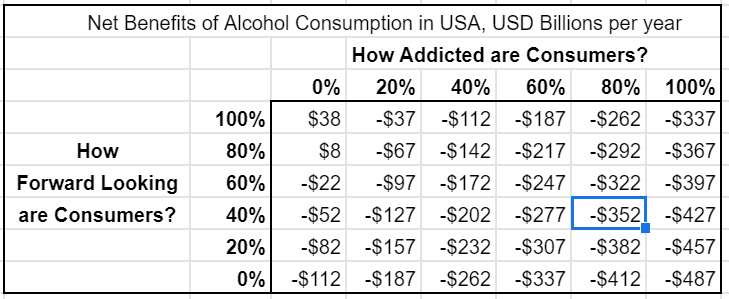
This allows us to produce a two-axis table, where the axes are how forward-looking consumers are, and how addicted they are. For 100% forward-looking consumers, the only harms are the externalities, and for 0% forward-looking, all harms are measured. For 100% addicted consumers, no consumer surplus is counted, and for 0% addicted, we measure the consumer surplus using traditional economic techniques. You can then choose a spot on the table based on your beliefs about what's going on in people's minds.

To demonstrate, we can do very brief and simple analysis of alcohol in the USA:

I personally believe that (on a drink-weighted basis) alcohol consumers are 40% forward looking and 80% addicted. They are somewhat aware of the long-term health consequences, but haven't fully internalized most of them. And their behavior is determined mainly by habituation or withdrawal avoidance rather than rational pursuit of pleasure. 

Obviously your beliefs may differ. So spend a few minutes thinking, and then once you've decided what you think reality looks like, you can pick a spot on the table I'm about to construct. Keep in mind that if you and your friends are relatively well-adjusted, in-control casual drinkers, your intuitions will be warped by your filter bubble. Most drinks are consumed by heavy drinkers.

Because I am doing this in my free time for fun and it wouldn't be fun to do a proper lit review, I grab data from the first paper I find online that seems credible, and use the following simplifying assumptions:

I assume that the only externalities are alcohol-caused crime and the costs to governments. All other costs are 'internalities' that only affect the consumer or their family unit and would be internalized by a rational agent. This means that while the total social costs of alcohol are about $250 billion, the external costs are about $100 billion (same source).

I assume that the producer surplus, i.e. economic profit, of the alcohol industry is roughly one-third of their accounting profit. (Note that in a fully competitive industry, producer surplus would be zero, so I'm assuming a bit of monopoly power, possibly driven by habit and brand loyalty) With a net profit margin of about 15%, this means that 5% of the money spent on alcohol is producer surplus. With total sales of about $250 billion, this is about $13 billion in producer surplus.

Data on consumer surplus of alcohol is much more sparse. The only semi-credible estimate that could be found in a lit review is based on London drinkers, and shows that utility from drinking is 150% of the price paid. So assuming that American drinkers are similar to London drinkers, then the consumer surplus for fully-rational informed consumers (utility minus purchase price) would be about $125 billion per year.

If consumers are completely non-addicted and forward-looking, then alcohol consumption in the USA has net benefits of $38 billion per year ($125 CS, plus $13 PS, minus $100 externalities). But once you move any significant amount from pure rationality, the benefits disappear and are replaced with significant net costs. 


Under my guess of 80% addicted and 40% forward looking, which was written down before I produced this table, net costs are about $350 billion a year. If we could magically get everyone to stop drinking, without suffering withdrawal costs, we'd see benefits valued at about a thousand dollars per person. Given that most of these costs come from problem drinkers, a hypothetical charity that managed to reduce binge drinking and alcohol addiction by 1% would generate benefits of about $3 billion a year.

Calculations are in this google sheet, feel free to copy it, and then enter other or better sources, or your own ranges or guesses for how addicted and forward-looking people are.

Edit 23 Apr: I just remembered/realized that the source I cited for alcohol harm did not fully monetize the life years lost. For a full analysis, you'd have to do that, and split them between the internalities and externalities. The main part of this post is the framework, so I'm leaving it as is, but please note that it underestimates the harms of alcohol by a lot.

Wednesday, January 27, 2021

Discontinuities and Discounting

Summary: Even with a zero rate of pure time preference, and persistent zero real interest rates, we should use discount rates of at least 1% for any real-world project or policy. Health, lives, or utility should be discounted because of the probability that a discontinuity in resources or policy or the state of the world will cause projected future effects to not happen. With policies that provide economic benefits, we must also increase the discount rate to reflect the fact that it will probably be more expensive to purchase lives, health, or utility as overall conditions improve.

This post is meant for economists, effective altruists, and others who are doing cost-benefit calculations over a long time horizon to decide what actions we should be taking now. I am trying to be as plain-language and non-technical as possible, which will involve simplifications of well-studied things. I do assume basic knowledge of cost-benefit analysis and time value of money calculations. Greaves 2017 is an excellent survey article for some of the relevant technical aspects, and this post builds on its foundation. 

Past use of Discount Rates
In the past, cost-benefit analysis was mainly used for investment projects, and was mainly concerned with money flows. Discount rates were based on the agent's opportunity cost of money, which was usually based on a market rate. There were no hard questions or philosophical considerations beyond "Don't waste money." Market rates were never close enough to zero, and time horizons were never long enough, for the considerations in this post to be relevant.

However, in recent years, people have started to use cost-benefit analysis as a decision analysis tool for many more kinds of policies, including those that do not use money at all but involve trade-offs between lives or health or utility today and in the future. This has forced a rethink of how to apply discount rates.

Pure Time Preference
In experiments, tests, and surveys, people always prefer things now to things later even when there is no possibility of trade and investment. This has been called 'pure time preference'. There are many good arguments that society or a government should have a zero rate of pure time preference i.e. it should care just as much about a life today as a life in 100 years.

I don't believe that there's really any such thing as a pure rate of time preference. I think that people discount the future based on uncertainty that the expected benefits will ever actually arrive. Of course, usually they may do this subconsciously, out of evolved heuristics. The monkeys who assumed things would reliably be around in the future died off, and the monkeys that grabbed what they could at each moment reproduced. We observe throughout history that whenever the economic and political situation becomes more stable, people's discount rate goes down and they start caring more about the future. Attempts at measuring time preference typically fail to adequately correct for these uncertainties.

I suspect, but am too lazy to prove, that hyperbolic discounting is actually based on a subconscious assumption of some fixed probability that the person is lying to you about ever delivering future benefits, plus a variable probability over time that they will be unable to even if they intend to. Hyperbolic discounting is entirely rational in any situation other than our weird world with giant reliable financial systems and strong enforcement of contracts, and people's instincts haven't caught up. (If I am right, an experiment that deliberately made the promise more trustworthy would see a lower discount rate, and I would love to see someone try to falsify this, even if I am proven wrong.)

Real Interest Rates
Everything will be discussed in terms of real values, not nominal ones, because tracking inflation is an unnecessary complication.

It makes sense to discount the future based on how much our money would grow if we just put it in the bank. There's no sense implementing a policy that has a 2% return if it costs us 3% to borrow money. For almost all of human history, governments paid a positive real interest rate to borrow. Now they don't, and it may be decades or more before they do again. Similarly, no individual can or will earn a positive real risk-free return on their money for the foreseeable future. A full discussion of this is beyond the scope of this post, but for our purposes it lets us zero out a complication. I'll make the simplifying assumption that governments will keep borrowing more until their borrowing costs increase and they pay zero real interest rates on all their debt, so we can just assume no interest.

Increased Cost of Utility
We don't care about money; we care about what money buys us. This could be lives, or health, or utility. The exchange rate between money and these things changes over time. When society is poor, or unequal, a little money goes a long way. As things get better, it is more expensive to do good.

Discussions of discounting often involve the Ramsey Rule, which is based on increases in wealth and the decreasing marginal utility of consumption, but I think that is both too technically intimidating, and also too simplistic because it just uses averages and does not take inequality into account.  

If people are using money at all intelligently to purchase utility, they'll be using it to increase the utility of the people who are worst off. This means that if inequality goes down in the future, or if the social safety net improves, the cost of purchasing utility will go up, probably significantly more than the overall economic growth rate. 

Our discount rate for a policy that has economic effects will be, at minimum, the expected annual rate of increase in the cost of purchasing utility. Ideally this would be estimated by forming a historical data set on the cost per QALY achieved by the 10% most effective charities, or by tracking the percentage of the population in various states of extreme distress or subject to easily preventable deaths, but as a kludge we can just double the real per capita rate of economic growth.

Discontinuities
The primary message of this post is that we must discount based on the fact that everything we do can only affect the future with a probability rather than a certainty. There are many things that could cause our actions to have no effect, and each of them causes us to increase the discount rate. I call these discontinuities: anything that causes a break between what we hoped to happen and what actually happened.

Any competent cost-benefit analysis takes into account known unknowns, listing various scenarios and averaging them for an expected value. But I've never seen one that explicitly accounts for the annual tail risks of unknown unknowns, the discontinuities that could scramble plans and predictions by making big changes in the world. These things can usually be safely ignored on a short time horizon, but over long periods they matter a lot more.

I will generally be speaking in terms of an annual discount rate, but as a simple example, imagine that there are three different things that each cause a 10% cumulative chance, between now and the time period we want to affect, of the plan failing. The expected value of the benefits is roughly 70% of what they would be if the plan was guaranteed to do exactly what we projected. (Technically the expected payoff is 0.9^3 ≈ 73% chance of success, but that assumes risk neutrality. A more realistic assumption of risk aversion decreases the expected utility, so I'll cancel them out and just add up failure probabilities for simplicity.) So if the plan gains us 2 utility on a success, our expected value is 1.4 utility.

However, we still spent the resources, meaning that we lost the ability to do anything with them today. This means that, when doing a cost-benefit analysis, we should discount all future benefits by 30%. If this plan gives us at least 30% more benefits than spending money today, we should do it, and if it gives us less, we should not.

In this example, the failure probabilities were fixed, so it is no different than a normal expected-value scenario analysis. But in reality, the chances of these things increase as more time passes. Every year, there is a chance of something scrambling our plans, either directly or by scrambling the entire world.

To gain an intuition for this, imagine that you are a university professor, with a big endowment and research budget, in a random developed country in the year 1920, and that you are implementing a plan to make life better for people in the year 2020. What is the probability that your plan will survive? (Keep in mind that there's a good chance you are Jewish and live in a country in continental Europe.) Then imagine that you live in 1820, or 1720. Consider all of the economic, political, moral, and scientific shifts that have happened in those years. What is the probability that anything you do can even persist at all in a form you intended? Even then, what is the probability that your plan actually made the world better, in a way that the people of the future agree with and appreciate?

So, our annual discount rate must always include the sum total of all the annual probabilities of everything that could possibly happen to make the plan fail or become irrelevant.

As a concrete example, consider a climate policy that costs a billion dollars a year but would, if consistently implemented for a hundred years, prevent a trillion dollars worth of damages in year 100 of the policy. (This is simplistic, but many proposed policies have a similar payoff structure.) The break-even discount rate is between 3 and 4 percent: with a discount rate of 3%, it's a good idea, but with a discount rate of 4%, it's a bad idea.

When determining our discount rate to use, we must add up:
1) the probability that something else will solve climate change in the meantime, perhaps a cheap geoengineering solution. If that happens, we wasted the resources.   
2) the probability that a future administration will overturn the policy. If they do so, the future benefits will never materialize. 
3) the probability that the country ceases to exist (or becomes conquered by a different power that changes the policy). If that happens, we don't get the benefits.
4) the probability of any form of existential risk that would not be affected by the proposed policy.
5) the probability of any form of catastrophic risk that reduces the population enough to make the benefits irrelevant.

All of those estimates should be based on an outside view whenever possible. For example, for #3, look at how many nations in the last 200 years have collapsed, or undergone a revolution, or been conquered, and how often they tend to last before that happens. Given that data set, I'd guess there is a roughly 50% chance of the country ceasing to exist in its current form over the next 100 years, so the discount rate, for just point 3, should be about 0.5%. 

Estimates of x-risk add 0.15% for point 4, and probably another 0.15% for point 5. Point 2 probably adds another 1-2% to the discount rate, as does point 1 (I am a tech optimist). So the point estimate is a 3.8% discount rate.

Of course, this assumes that discontinuities result in zero benefit. If they still allow some benefit, the math gets more complicated, but we can approximate that by adjusting the discount rate downward for the policies where a discontinuity still gives some benefit. If there is a 0.5% chance of government change, but we assume a 50% chance that a revolution or invasion does not change the policy, then the adjusted discount rate is 0.25%.

A less controversial policy, with less chance of being made irrelevant by other means, might have a discontinuity-based discount rate as low as 1%, but I think this is as low as we can safely go. Chaos happens, and we are entering an uncertain age.

(Addition March 2022: The damages from carbon emissions that happen today will eventually happen regardless of intervening policy, but could still be made irrelevant by geoengineering or x-risk, so I would use a 1.5% discount rate for the Social Cost of Carbon, even with a zero rate of time preference. By a happy coincidence, this is the utility discount rate used by the standard models.)

Because people don't deal well with very small probabilities, it may be best, when doing the estimation (which will require surveys of experts) to focus on 10- or 25- or even 100-year blocks of time, and then divide.

Then, if the benefit is an economic effect rather than a pure impact on health or lives or utility, we also have to add the expected annual increase in the price of utility, conditional on no discontinuity. (Technically the total discount rate we should use is (1+u)/(1-d) - 1, where u is the growth rate in utility cost and d is the annual chance of a discontinuity. This will always be slightly higher than d + u, which will matter in the long run, but since these things are estimated with high uncertainty the difference is well within the confidence interval so we might as well keep things simple.)

To make an analogy to finance and investing, the discontinuity probability is the risk premium, and the utility price increase is the risk-free rate. We should only invest if our return is higher than both of these put together. In finance, the risk premium of the safest investment is assumed to be zero, and everything else is compared to that, but in this case, there is nothing with a zero risk premium, because we are comparing a certain result today with an uncertain result in the future. Anything we do has risk.

As a second example, consider a private action, perhaps setting up a think tank to research ways to stop a catastrophe, and that nobody else is trying to solve the problem or ever will. The discount rate is based on:
1) the probability that the organization suffers value drift.
2) the probability that the organization is taken over by a malevolent or selfish actor.
3) the probability that an outside force seizes all of its resources.
4) the probability that the government, society, and/or economy collapse for some other reason, making it impossible to continue work, or that another catastrophe makes the work pointless.
All of these risks increase with time, so the further out the benefit is, the less likely it is that the money spent will accomplish anything.

Even in the extreme case where the plan, once set in motion, cannot be disrupted, for example a rocket launch to nudge the trajectory of an asteroid that will hit the Earth in 200 years, we should discount. There are still discontinuities. Every year in the intervening time, there is a probability that people will develop a cheap asteroid deflection system, or that the asteroid will be consumed by mining, or that some other x-risk will make our effort irrelevant.

It should be clear by now that this is not an estimation problem for economic data sets and equations with greek letters. This is something we must think of by looking at historical trends in the appropriate reference class. Look at what has happened to similar plans or organizations in the past, and estimate the annual probability of a discontinuity of policies or resources between now and the time period we wish to affect. 

Scientific and Moral Uncertainty  
I'm less confident about this, and it doesn't affect the main result, but I suspect that epistemic uncertainty also increases our expected discount rate. Learning that the world doesn't work the way we thought it does is another kind of discontinuity. The annual probability that our theories are wrong, and that our policy is therefore mistaken, should be added to the discount rate.

Given how much our science and understanding of the world has changed and improved in the last hundred years, it seems reasonable to increase the discount rate by another 1% to account for epistemic humility and the potential realization that what we think we know is wrong. 

I think the annual discount makes sense, because long chains of causality introduce more chaos and more opportunities to be wrong. It's kind of like weather forecasting: we can be pretty confident in our ability to predict things a few days out, but after 10 days predictions are basically just swallowed up in chaos. 

Currently, with economic forecasting of government policies, it is rare to go out past 10 years, because of this kind of uncertainty. Assuming no large-scale change in economic conditions, we can predict the short-term effects of a tax or transfer policy fairly well. The Congressional Budget Office can know with decent precision what the effects of a tax cut will be over the next few years, and how that will affect labor supply and similar things. But there are a lot of second order effects and long-term adjustments that they don't know how to deal with, so as we project the changes of a policy more years out into the future we become less and less certain of anything. Typically they do this by increasing the error bars, and just stopping when they get too big.

But if we were doing our best to predict the effect of a large-scale change, because if we don't then people will treat all the side effects as though they did not exist, and while we are uncertain we know they are not zero, it might be more responsible to run the model the best we can, include its probabilistic output in the expected value calculation, and then add in an extra 1% or 2% discount rate on all future effects to account for the extra chaotic uncertainty.

Conclusion
None of this changes the fact that the value of preventing human extinction is huge, at least three orders of magnitude more than the entire annual world GDP. And that is just counting the VSL-based value that currently-existing humans place on preventing their own death; it does not include the value that future people place on existing.

In fact, this discounting strengthens the case for making serious sacrifices to stop x-risks. Anything else we might do to affect the far future is rendered irrelevant by the discounting, including the harmful effects of significantly slowing down economic growth. This is because there will be great unpredictability in human affairs as long as they still exist.

It can be argued that, ironically, the ethical implication of all this consequentialist math is to push people into a precautionary-principle-based deontology where we focus all of our actions on stopping whatever is likely to cause existential or catastrophic risk in the short term.  

However, if we cannot do anything about an x-risk, then we should be doing things to help people now rather than in the far future. The certainty of actually helping now is better than a tiny probability of a plan surviving and doing what we think it will, and this is reflected in the discounting.

Friday, January 22, 2021

Radical Tax Reform

I know that this is probably-impractical utopian thinking, but whenever I discuss related ideas in conversation, people ask me to write it up, so here goes:

The core idea is to get rid of all current taxes, and some existing government power and regulation, and replace them with externality taxes and progressive consumption taxes.

Externality Taxes: The Basics
All significant, measurable externalities should be taxed. Whenever possible, replace existing command-and-control regulations with a measure-and-tax system. Instead of people paying real economic costs for regulatory compliance, the money goes straight into the treasury as a transfer. This increases economic efficiency and will end up with less overall compliance costs for many businesses.

I've estimated that just the basic and obvious externality taxes will raise one to two trillion dollars a year in the USA. This gives us between a quarter and a half of the government's budget. In addition, there are some other externalities to tax:

Corporate Power is Taxed with a Progressive Corporate Income Tax
When considering only economic efficiency, i.e. avoiding the distortionary unfairness of double taxation, the ideal corporate income tax is zero. However, corporate size and market concentration are plausibly negative externalities that should be taxed.

All small businesses in competitive markets will pay no tax. Large companies pay exponentially increasing tax rates based on size and market concentration. If this is calibrated so that this is roughly revenue-neutral with the existing corporate income tax system, it would raise a quarter trillion dollars annually. 

I have no idea if a quarter trillion is an appropriate estimate of the annual harm done to our politics and society by concentrations of corporate power. I doubt anyone has estimated this in any sensible way. Probably the easiest way to do it would be a QALY survey. Fairly or not, many people hate big business, and would prefer to live in a world where it did not exist. Suppose that, on average, living in a nation with our amount of corporate power costs everyone one-thousandth of a QALY i.e. 1/20th as much discomfort as mild lower back pain. A third of a billion people, times a half a million dollars per QALY, times 1/1000, equals a sixth of a trillion dollars, which is pretty close to the current tax.

Other Externalities
Basically any problem you have with our society can be thought of as an externality to be taxed. The tax system, rather than the criminal justice system or any other power of government, should be the first tool to reach for to try to fix things. 

Advertising to children can be taxed. Advertising to anyone can be taxed. Political lobbying and large donations can be taxed. Actions that break up or damage families can be taxed. Conspicuous displays of wealth can be taxed. Harming the cultural foundations of our civilization can be taxed. Companies failing to hire in an equitable way can be taxed. Social media hate mobs can be taxed. 

I don't know if it would be best to have each separate tax require an act of Congress, or to give the executive branch broad enabling powers to identify externalities. Probably it would be safest for each one to require separate, narrow, enabling legislation. Congresspeople would propose tax-enabling legislation in response to constituent pressure. The legislation should include a rough estimate of the damage caused by the externality, and exactly what actions will be taxed and at what rate. Then we can have a productive discussion revolving mostly around checking the math and thinking about practicalities and side effects rather than shouting at each other. Once the tax is in place, people can either pay it or change their behavior.

Progressive Consumption Tax

Even if we identified all harms that could be profitably taxed without violating rights or causing too many bad side effects, it probably wouldn't be enough money to fund the government. We need another source of money that is as non-distortionary and politically sustainable as possible.

Whenever you tax something, you destroy it. Income taxes discourage productive work and investment. Wealth taxes, if only placed on wealth that the state can see, generate an economy-destroying incentive to hide money rather than invest it. Consumption taxes, on the other hand, have far fewer problems, and possibly some benefits, like discouraging extravagant lifestyles that fuel envy and social division.

In order to allow progressivity, and to avoid double-taxation of retired people and people who have saved, and to more easily transition from the current system, we implement it as an alteration of the income tax system. You would get taxed based on the money you withdraw from the bank rather than the money that goes from your employer into your bank account. Bank accounts that existed at the time of the tax changeover are exempt, under the assumption that you already paid income tax on them, and all of your income from that date forward is deposited in a new account.

Instead of your employer withholding money from your salary and submitting tax information to the government, your bank does, at the time you withdraw or spend it. (Assuming direct deposit. If you have an actual check you cash, it gets reported by the employer as normal and you are assumed to consume all of it, but you get a tax refund for depositing money in an investment account) All brokerage accounts etc. are considered 'in the bank' and untaxed. Charitable contributions are untaxed. Aside from that, the current tax brackets would be roughly the same, except we add lots of increased tax brackets for people who spend more money. Anyone who lives a lavish millionaire lifestyle pays 70%+ marginal tax rates on that spending, and seven-figure and higher lifestyles can be taxed at 80%+ At the top end, you'd lose almost 90% from each withdrawal, so you pay the government almost ten times as much for your consumption as it costs.

Some people will complain that this is unfair, because rich people can 'evade' almost all of their taxes by living a frugal middle-class lifestyle while their money sits around growing. But this is exactly the kind of behavior we want to encourage; it would increase investment and economic growth. We should think of the consumption tax as a kind of externality tax: Purchasing things takes them away from others, and plausibly harms them by decreasing their perception of relative status, but earning and storing money doesn't hurt anyone (assuming all the harms involved in what you did to earn the money are taxed properly as externalities).

Tax Liquid Wealth that Produces Power? 
We are probably already taxing lobbying and political donations as an externality, and of course they also get taxed as consumption. But potential power is still power, and it may be possible for large concentrations of wealth to exert improper influence, without paying any tax, by merely threatening to spend a lot on lobbying. If this turns out to be a problem, we can have a wealth tax on large pools of liquid assets. Make sure people can escape this by locking their money up in long-term investment projects, or by signing some kind of binding pledge to never spend money on lobbying or influence.

That is basically it. We've switched away from taxes that give bad incentives and toward taxes that give good incentives. In most cases, 'tax evasion' is stopping doing things that harm people. The next two points are details on stopping nonproductive tax evasion under this new system:

Include all Perks and Benefits as Income
In order to prevent powerful executives from evading taxes by disguising consumption as business expenses, we can count absolutely everything they get from their employer as income. The cost of all benefits is taxable income. In addition, something like exclusive use of a company car is income equal to the rental cost of the car. Use of an office counts as income equal to its rental cost.

All business travel is income equal to what it would cost an outsider to participate, e.g. a trip to Davos counts as income equal to the airfare plus the hotel cost plus all expenses plus whatever it would cost an ordinary person to bribe or buy their way in. If the event is so exclusive that there is no observable market for its tickets, this cost is assumed to be in the tens of millions.

In order to enforce this in an incentive-compatible way, the government collects taxes from companies on everything they spend on employees at a rate a little higher than the highest possible marginal tax rate of the recipient. (If a company has any employee who gets over a hundred of million dollars including benefits, it pays a tax on any benefit they get equal to ten times the total cost of the benefit.) Then individuals declare the value of all benefits and perks they received, in order to get a tax refund on them. 

For example, if consuming all your income (after including the benefits) would put you in the 50% tax bracket, and you got $100k worth of perks and benefits, then the company paid a bit more than $100k on your benefits (at a 50% consumption tax, you need to withdraw $200k to purchase $100k of consumption). If your actual consumption only takes you to the 40% bracket, you'd get a tax refund of a bit more than $33k. (with 40% consumption tax, you need to withdraw $166k to end up with $100k, so the proper tax would have been $66k.)

The more benefits you report, the higher your refund is, so you have an incentive to report everything you possibly can, even at the highest bracket, because the company was forced to pay a bit more. If employees collectively report more in benefits than the company reported and paid taxes on, the company pays the difference plus an additional fine.

This would result in total compensation becoming more transparent, and taxed properly, and would probably quickly settle down into everyone being paid in mostly cash, which would end a lot of current economic inefficiencies like health insurance being tied to employment.

Include Imputed Consumption Value of Non-investment Assets  
In order to discourage certain kinds of tax evasion, and to properly measure lifestyles, we also need to count as income the consumption value that you get from owning things like yachts and mansions. Most or all of this would apply only to people in the new lavish-lifestyle tax brackets; it isn't sensible or desirable to try to collect these taxes from people in lower brackets.

The imputed consumption from any non-investment asset you own is added to your income. For most things, this can be the rental market value. If you own a home, the government uses real-estate data to look up how much it would cost to rent a similar home, and increases your income by that amount. Same for cars, yachts, vacation property, etcetera. 

In cases where there are no rental markets, we do our best to estimate its auction value and assume that the consumption value is a fixed percentage of that. For example, someone hanging a Picasso on their wall, or who owns a million dollars' worth of jewelry, would pay a percentage of its value each year.

In order to avoid double-taxation, you subtract from the property value the amount that you paid for it. So if you paid $300k for your house, your imputed income is reduced by the rental value of a $300k house. If your house still has that value, you pay no additional taxes. If you bought it before the changeover, it is assumed that you paid appropriate taxes, and if you bought it after the changeover, you already got taxed on the money that left your bank. But if the house value has gone up since you bought it, you pay based on the difference.

This system taxes speculative profits rather than productive investment. Purchasing something that later rises in value is taxed, in a way that buying stock in a productive enterprise is not. The current system gets things exactly backwards, giving people strong incentives for unproductive real estate and art speculation.

Monday, October 12, 2020

Worthless Replicators

Futurists often think that self-replicating machines will change everything. But It's possible to imagine a world where self-replicating technological systems are common, but nobody bothers to use them because they are economically and militarily worthless. In a world with relatively strong property rights and relatively low transportation costs, this could be the expected state of affairs.

The key insight here is that a civilization (meaning a combination of machines, ideas, and people) already is a self-replicating technological system, and every part of that system will always be able to operate more efficiently, through specialization and economies of scale, than anything at the same tech level that must also be small, portable, self-contained, and/or limited to local resources.

It's pretty much a guarantee that no matter what level of technology you have, the output of a portable fabber system is always going to be worse than the output of a factory. Mass production of a single thing by a large facility designed to do that thing will always be more efficient than production from a device that must be small and capable of flexible output. This is true no matter what tech level you have; any tech that makes a fabber work better can also make a factory work better.

For example, in our world, it's easy to see that the output of a printing company is always going to be better, and cheaper per page before delivery costs, then something that you print out of your home printer. Sure, the output of your home printer might be better and cheaper than the output of a printing company in the 1950's. But someone in the 1950's who correctly predicted the capacity of a home printer, and then predicted that nobody would ever buy a printed book or magazine because the home printer could print things on demand more cheaply, would be mistaken. The factory tech also advanced.

It is certainly possible to have a world where all of the components of a replicator can easily come out of a factory, but the output of that replicator (be it useful things or other replicators) would be much more expensive, in terms of resources and time, than the factory version.

It should also be easy to see that any weapon or military system with the design constraint "Must be capable of self-replicating" will be far less cost-efficient than any weapon of a similar tech level that does not have that design constraint. A military power that builds a lot of self-replicating weapons will lose to a power that spends similar amounts of resources on building non-replicating weapons.

People seem to think that resources no longer matter once you have self-replication. But this is not true at all. Any resource that can be consumed by a replicator can also be fed into a factory, and the factory will do a much better job of converting that resource into wealth or power or whatever else you care about.

People also assume that self-replicators will dominate everything because of their capacity for exponential growth. But that implicitly assumes that the adversary is doing nothing with that time. All well-functioning economies grow exponentially whenever they have access to resources, and they do so at a rate based on their productive efficiency. Sure, if you drop a self-replicating weapon in the arctic tundra, then in 100 years you might have billions of drone weapons. But an adversary civilization that spent 100 years converting a similar mass of arctic tundra into weapons using factories will have far more of them (and their weapons will all be 100 years more technologically advanced than yours, and your drone control system is 100 years old and probably easily hacked by modern tech).

On both long and short time scales, factory output dominates. In the short run, they can pump out thousands of things while you are on the first few generations of replication. And in the long run, their increased efficiency and technological advancement will allow them to exponentially increase their productive capacity at a faster rate than your replicators. Your replicators may be doubling every month, but their economy is doubling output every week. You are building things to a more restrictive design constraint, while they can use that tech to crank out specialized factories that efficiently build weapons and factory components.

Of course, all this is before travel costs. If you want to turn an asteroid into a colony, moving the factory to the asteroid is going to be much cheaper than moving the asteroid to Earth and then shooting the factory output back into space. But even in this situation, there is little economic incentive for self-replication. A machine (or system of machines and people) that turns an asteroid into a colony will always have much better performance if it does not also need to be able to create a new colony-creation machine in the process.

So even in the case of a spacefaring civilization with access to self-replication technology, it seems like there's very little economic or military incentive to drop a replicator in an asteroid belt and have it convert the belt into something. No matter what you're trying to accomplish, deploying something built in a large modern efficient factory would always be able to do it better, faster, and cheaper.

The only real motivation for using completely self-replicating systems is independence. If you want to be liberated from the large efficient systems that enable modern civilization, then a self-replicating system loaded with all the important knowledge of civilization can do it for you. But your quality of life, per resources spent, will be far lower than any citizen of that civilization. It will also be significantly lower than anyone who wants to live off the grid but does not insist that their off-grid house and fabber be capable of self-replicating.

Some people will choose to do this, but they will only exist as long as a large civilization actively protects them. They will be utterly incapable of resisting any kind of military aggression, and they are sitting on useful resources. Anything that is capable of sustaining them is also capable of generating wealth for the larger more efficient civilization. So they will never have any real independence in a geopolitical sense, and will always be dependent on a sovereign power for protection.

It will be a performative delusion of independence, probably nestled safely in the territory of a major power while paying property taxes. And this is only possible if the property taxes are a tiny fraction of the economic worth of the resources; if taxes are higher and based on market rates, then the controller of the replicator will never be able to afford them, because the large-scale systems are capable of generating much more wealth from those resources than the smaller systems whose efficiency is constrained by a need to self-replicate.

So in whatever sci-fi setting you like, be it plausible hard sci-fi or something like the worlds of Star Trek or Star Wars, self-replicating systems could be kind of like bitcoin. There's a bunch of random tech geeks that swear it's the next thing, but nobody's ever actually able to find a practical case for it. Occasionally their community makes a useful tech breakthrough, which is immediately absorbed into existing systems and used to make them better.

Some rando could think they're wealthy or powerful because they control a Jupiter-sized mass of mobile self-replicating probes, but traders don't buy anything from them because other people are selling it more cheaply, and any military power's reaction is "Whatever. I could destroy that in an instant but I just don't feel like it right now"